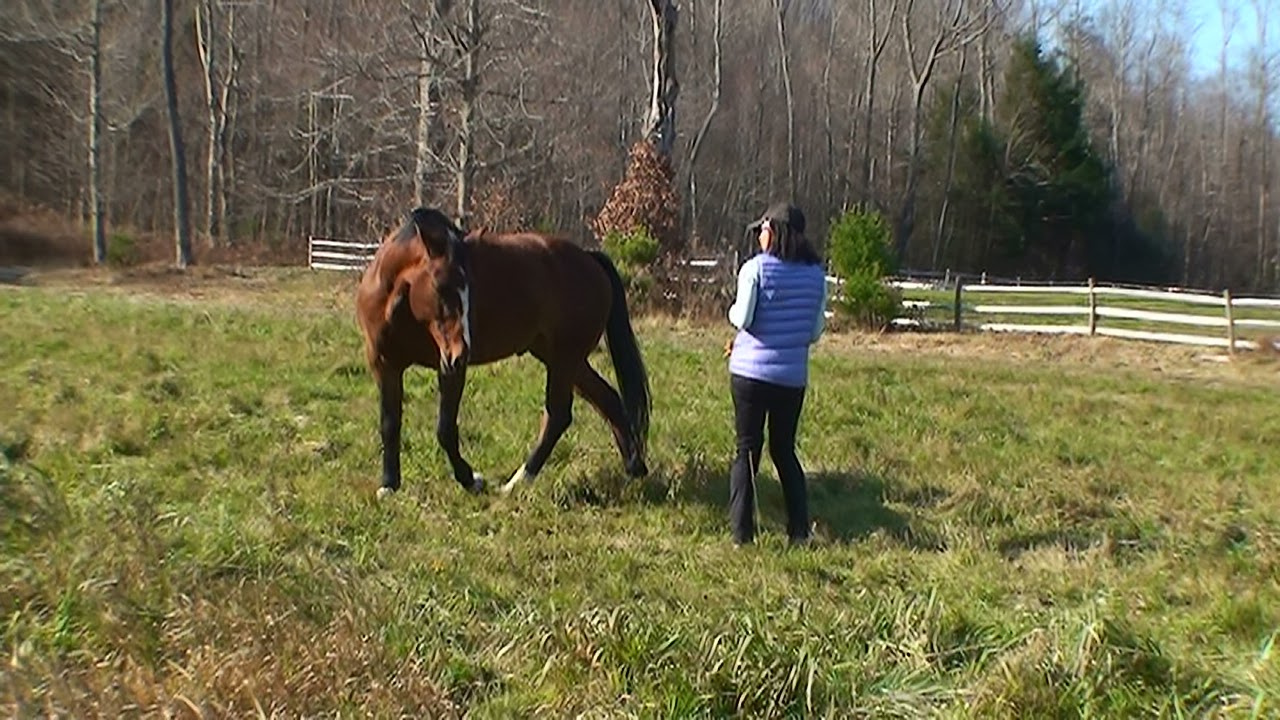
What is the difference between Trained Liberty and Liberty Training? With the increasing interest in Liberty and Liberty play, I have noticed that there is a distinct difference between what I call Liberty Training or Tricks and Trained Liberty.
Liberty has been around for some time in many ways shapes or forms. It is used in circuses, entertainment, and even movies and TV. This Liberty constitutes mostly what I call Trained Liberty and tricks at Liberty. It is distinctly different than Liberty training or play. Horses trained in Liberty are taught a lot of their cues in tack and under restraint of some kind as opposed to being at Liberty and free to come and go in the conversation as well as change the agenda if they want to. Liberty taught in round pens or small areas also constitutes the possibility of the horse not having the ability to leave the conversation, change the subject and be free to communicate in a two way conversation.
What Liberty Training looks like to me is a free flowing organic conversation that changes moment by moment. I have no feeling of what my horse "Should" be doing. Only a feeling of enjoying the conversation, and the companionship intertwined with whatever we may be playing with. Take the pressure off. There is a really nice space to train in when we do that. It opens door ways to more interesting, fun training for both horse and person. This does not mean you are not communicating or even communicating quite strongly at times, It just means there is no pressure to achieve a particular outcome or result. Just you saying something, and the horse is allowed to say something. And then you listen to what the horse says. Then you say something back that seems appropriate in that moment.
I have hula hoops in my ring that are on the ground for figure guides and Mercury keeps showing me that he would like to work with the hula hoops when he is at Liberty. He clearly goes over to them and puts his front feet in the hoop. There are 4 and he will proceed to the next one and do the same. I have never taught him this and he offers it as his own idea. I am interested in this game he is showing me that he made up. Stand in the hoops with your front feet. I might then elaborate on this game by adding another piece to it. This to me, is the spirit of the Liberty play. It is free, organic and two way. Even when I am practicing more and more advanced Liberty play, I am always looking for my horses ideas, suggestions and input. I am always pleasantly surprised by what I get. I have a photo series of what to me shows the interaction I desire with my horse at Liberty. It is all spontaneous, co-creative, in the moment and a lot of fun! Happy New Year!
http://www.fdhorsemanship.com/
Showing posts with label western. Show all posts
12.30.2013
10.12.2012
Horsemanship for Wellbeing
I'd like to talk about Well-being and how we can approach our horsemanship with both of our Well being as a priority.
As a trainer who does Yoga, I very much bring the Yogic mind to my work, teaching and training. This is not only in the physical sense of a flexible strong posture, but also the mind-body connection.
In pursuit of the best relationship and training program possible with my horse. I must focus first on the Connection and Friendship, Then I must stay mindful of who my horse is, where they are in there physical state, and what is most fun, healthy and beneficial to them.
Combining a Natural Approach to Classical Dressage with Yoga and Physical Therapy Principles allows me to bring my horses along in a way that is supportive to not just their bodies but their minds as well. I see myself as a sort Yoga instructor/Physical therapist for my horses. Part of my daily work is to come up with gentle supportive Liberty-Line-Mounted progressions that are not only beneficial but fun for both of us. In Yoga, you never push the body beyond what it can comfortably do and still stay breathing and relaxed. You listen to the body very carefully and do just enough to have a benefit.
An important mind set to have when working with a horse is that you are a Physical therapist or Yoga instructor. I call it staying in the PTYI (Physical Therapist/Yoga Instructor) mind. When we stay in this mind, we wont push a horse harder then is beneficial for their Well being. When you introduce an exercise, Imagine it is your horses' first Yoga or PT session ever. Then imagine yourself having to go to your first Yoga/Pilates class. You would like an instructor who would not ask you for anything harder then you could do. If you were sore and even injured after the first session, you most certainly wouldn't want to go back for another session.
Classical Dressage is in fact Yoga/Pilates/Physical Therapy for horses. It belongs in every program regardless of discipline as the training foundation. Thoughtfully and conscientiously applied, it can improve your connection further with your horse on the ground and mounted. It can help your horses mind-body connection and can rehabilitate some horses that have extreme Symmetry issues.
It can become a form of meditation together if you avoid the Left brain, perfection, hamster wheel trap so many people fall into. Each day you can meet together and do your "Yoga" session at Liberty, In Hand and Mounted. It doesn't matter whether you ride Western or English. It's all good.
I will be adding new exercises and patterns to the FDHorsemanship Virtual Clinic so be sure to check it out! In the mean time, Enjoy this video which to me, shows all facets of what I look for in my program with my horses. Joy, Fun, Connection, Technical play, fitness and suppleness play, and horse Yoga and Physical Therapy!
6.16.2012
Goings on
For those of you who don’t already know, I am in the UK
this week for clinics at the New Horse in Motcombe. I’ll be sure to share photos and
updates as always.
I am pleased to see that this year’s clinic sold out and
that people are really taking a keen interest in not only building stronger
bonds with their equine partners, but training their horses in empathetic, fun
ways as well.
I finds myself globetrotting yet again to new places and new
and familiar equine and human faces. I will be in Kent, WA October 5-7 at Reber
Ranch, I am going back to Carterton, NZ for another fun clinic November 30th-December
2nd, and going to Strath Creek, Victoria, Australia December 8th-10th.
This will be my first visit ever to Australia and I am super excited to meet
new horses and their humans and assist them on their journey and bond. I didn’t
forget about people on the east coast. I have been to Charlottesville, VA,
Schoharie, NY and Plainfield, MA. If you missed those, I have another weekend
possibly coming up in Virginia in the fall (check my calendar for dates TBA). I
also have a 3 day clinic at Backacresfarm.com (Plainfield, MA) coming up Labor
day weekend in September that is about half full now. As always, the broad
topic will be Liberty-Line-Mounted, FUN!damentals and Bitless/Liberty riding
for those interested. As always, the clinics are shaped by the participants and
highly customized to meet the needs of those who attend. If you’re interested in
attending a clinic or would like to organize one in your area, contact me or
Check my calendar link for details and more info here fdhorsemanship.com
I was thinking a lot this year about what my job is and the
true purpose of my work/play. The answer is, I help horses and their people
find more joy and fun. No matter what the surface goals or issues may look
like. I help people and horses communicate better with each other. Growing up,
I worked with a dog trainer who used to say he was an interspecies
communicator. I often feel like this is what I do as well. He actually helped
me on my path to animal training. Believe it or not I worked with dogs long
before horses even though my passion for horses started at a very young age. In
the past few years, I added Dog Training back into my services. Dog training
clinics anyone?! The interesting thing is I brought a lot of what I call
Natural Dogmanship to the horses and Natural Horsemanship to my Dog Training. I
find the two species quite similar despite one being prey and one predator. Their
social culture is similar because both naturally live in groups. Sometimes I am
called upon to help horses and dogs recognize each other as fellow family
members for their people. I have to explain to them that people often include
many different species in their family when they have a love of animals and
that they should look their people to help them all understand each other and
feel safe and friendly.
One of the things I bring up in my clinics when I am
teaching Connection exercises inspired by Carolyn Resnick is the reason dogs
are so bonded and connected to us naturally is because we “Share our Territory”
with them all the time. It helps illustrate the importance of the first
exercise we do with our horses to develop the same strong bond. For that
matter, this exercise strengthens the bond with any species or person. Hope to
see you soon at an upcoming clinic. I love meeting all of you in person!
| One of my favorite UK friends |
3.27.2011
Soft vs. Light
![]() |
| Here I am working with a Mare that had a tendency to be Braced in her Mind and movement on a Mind and Body softening exercise... |
My Interpretation of Light is a horse or a response to a cue that is very sensitive or even reactive or Over-reactive. So there are degrees of lightness that can actually be too light. The horse may over react or move too quickly so the movement or action is too fast and lacks quality and flow. This is for sure desireable in some disciplines but it can cause mis-communications between horse and rider. This can be a horses natural temperament or tendency or they can be taught to be "Lighter" in their responses if they are a bit un-reactive or slow to react.
Softness to me is about Suppleness, flexibility, a calm mind and flow in the horses movement, body, and mind. There is Relaxation, Rhythm, and fluidness between horse and rider whether you are moving at speed or slow. You'll note that I said a calm mind because to me you can not have true "Whole" softness without a calm, trusting, happy, minded horse. You can not manufacture softness with gadgets, bits, and force.
Now let's talk about Light versus Soft in the Rider. A rider can be Light all the time in their communication or very heavy handed figuratively speaking. Using strong cues always "shouting" so to speak at the horse. This will cause a horse to become perhaps no longer Light where he once was. So we want to be careful of training that into a horse and thinking it's their problem not one we created. A person needs to understand the full spectrum of "Request levels" starting with a whisper and escalating to a firmer (not louder) Conversation and everything in between.
Which leads to Softness in the person. All the same things apply here Suppleness, flexibility, a calm mind and flow in the persons movement, body, and mind. There is Relaxation, Rhythm, and fluidness between horse and person because you are able to effectively mirror the traits you are asking for from your horse. And again without the calm, happy, mind and body, you can not have true "Whole" softness in yourself.
It is always good to ask yourself as the Leader in the relationship between you and your horse, if you can do what you are are asking your horse to do whether it's be Calm, Be Fearless/Courageous, Flexible, Responsive, Energetic or Quiet. Whatever it may be, It starts with us.
http://fdhorsetraining.com/
5.04.2009
New Series: The Training Pyramid

I have wanted to talk about the Training Pyramid (or Scale) for some time as I believe if you understand it and use it, it will help you with even the most basic training of the pleasure horse. Whatever discipline you ride or train, it is a simple comprehensive guideline to successfully moving up the more advanced manuevers. What is the Training Pyramid you ask? Well it may be associated with Dressage mainly, but as a student of Horsemanship and Trainer of all disciplines, I use this system to start, train, and problem solve issues as I go. The image you see at the top is meant to be read from BOTTOM to TOP. It is a system that basically if followed carefully and understood clearly will provide you with a simple formula for training. So Rhythm is the first focus of the system. Look at Rhythm as the first grade or entry level of the scale. You start here and you get it as close to perfect as you can before you go to the next stage, which is Suppleness, and so on. I will get into what they are one at a time in each part. When you combine this with a Natural Horsemanship philosophy, it is win win. Stay tuned for the next section in the series.
FDT
Subscribe to:
Posts (Atom)